Contents
- 1 IQ Option fees at a glance
- 2 Does IQ Option charge a commission on trades?
- 3 Overnight funding (swap) on CFDs
- 4 Inactive account fee
- 5 Closure fee for unverified accounts
- 6 Withdrawal fees and limits
- 7 Deposit fees
- 8 How to check the fees for your own account
- 9 Frequently Asked Questions
- 10 GENERAL RISK WARNING
Last updated: 4 October 2026. Fees checked against IQ Option’s official pages on that date.
This guide lists the costs you can meet on IQ Option, which of them you can avoid and where to check the current figures for your own account. IQ Option runs through more than one company. Visitors from the European Economic Area (EEA) are served at eu.iqoption.com by IQBroker Europe Ltd (formerly IQOption Europe Ltd), which holds licence 247/14 from the Cyprus Securities and Exchange Commission (CySEC) and offers CFDs only. Binary and digital options are offered on the global platform at iqoption.com for other countries, which IQ Option’s contact page says is operated by SKY LADDER LLC of Antigua and Barbuda. Each rule below says which source it comes from.
IQ Option fees at a glance
- Commission per trade: None charged separately. The cost is in the price: an option pays less than you risk, a CFD has a spread. (Official fee pages)
- Binary option payout: 82–88% of the stake on a winning trade, in our 70 Practice trades on 2 October 2026 (Our test)
- Overnight funding (CFDs): Charged for each night a CFD position stays open. The asset information panel shows the current rate. (Official fee pages)
- Inactive account: €10 a month after 90 days without a trade, never more than the balance (EU and global fee pages)
- Closing an unverified account: Up to €5 when the balance is €5 or less (EU and global fee pages)
- Minimum deposit: $10, €10, £10 or 175 MXN on every method (Global deposits page)
- Minimum withdrawal: Global platform: $2 by card or e-wallet, $10–36 by bank transfer or crypto, depending on the method. EU entity: €2, or 100 EUR, USD or GBP by bank wire. (Global withdrawals page; EU help centre)
- Withdrawal fee: Global platform: one free withdrawal per calendar month, then 2% per withdrawal, at most $30, €30, £25, 620 MXN or R$125. EU entity: no bank-transfer fee for EEA clients, $31 per bank transfer outside the EEA. (Global withdrawals page; EU fee page)
- Deposit fee: None: 0% on every method. Your bank can charge for currency conversion. (Global deposits page)
Sources: EU trading specifications and fees, global trading specifications and fees (archived 20 July 2026), EU help centre: withdrawing funds, the global withdrawal conditions and deposit conditions pages (viewed from our Mexican test account on 4 October 2026) and EU regulation page.
Does IQ Option charge a commission on trades?
No separate commission is charged when you open or close a trade, but trading is not free. The cost is built into the price of each product:
- Binary and digital options: a winning trade pays less than a losing trade costs. In our Practice test a win paid 82–88% of the stake while a loss cost the whole stake, so at an 85% payout you must win more than 54% of trades just to break even. The gap between the two is the platform’s margin.
- CFDs on forex, stocks, crypto, commodities, indices and ETFs: you pay the spread, the difference between the buy and the sell price, when you open a position, plus overnight funding for every night it stays open.
Our strategy videos show these costs in real Practice trades; see seven strategies tested on the platform.
Overnight funding (swap) on CFDs
IQ Option’s fee pages state that overnight funding may be charged for holding open positions. The rate depends on the asset and on whether you buy or sell, and it changes over time, so check it before you keep a trade open overnight: open the asset, then its information panel, which lists the current overnight funding for buying and for selling.
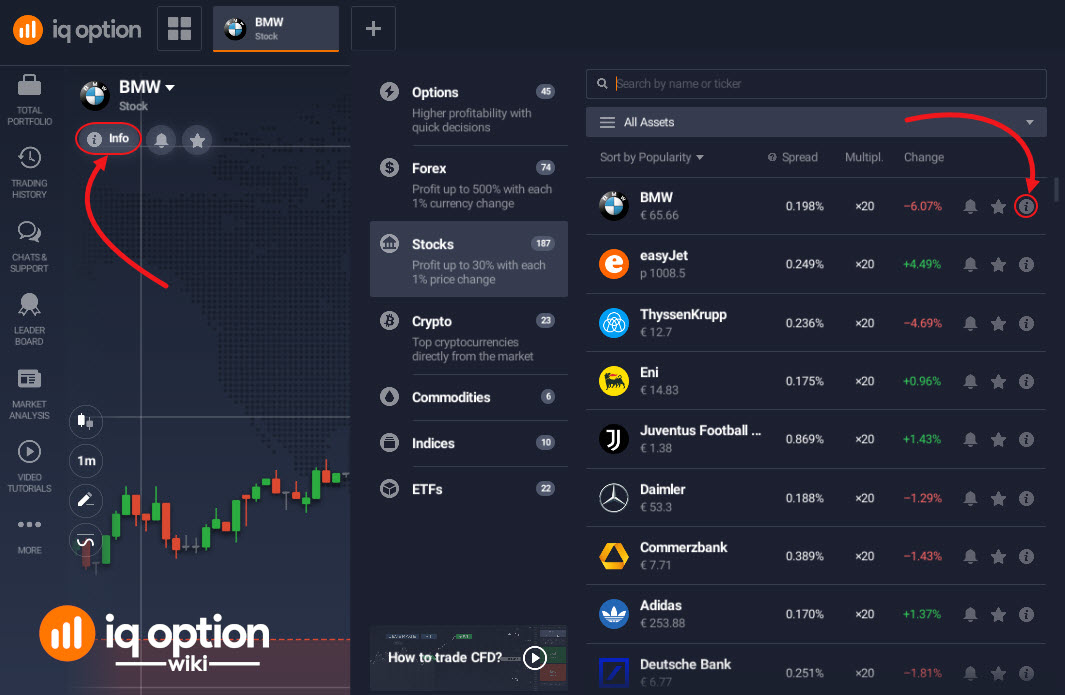
 Overnight funding rates in the asset information panel (earlier platform version)
Binary and digital options have no spread and no overnight funding, because they close at expiry.
Inactive account fee
If you place no trades for 90 consecutive calendar days, IQ Option may charge an inactive-account fee of €10 (or the equivalent in your account currency). It is deducted every month until the account is active again and never exceeds your balance. The EU and the global fee pages state the same rule. To avoid it, withdraw money you do not plan to trade before you take a long break.
Closure fee for unverified accounts
If an account is closed because it was never verified and its balance is €5 or less, IQ Option may charge up to €5 for closing it. Verifying soon after your first deposit avoids this and keeps withdrawals quick; see how account verification works.
Withdrawal fees and limits
- Minimum: $2 (or €2) for most methods, and 100 EUR, USD or GBP by bank wire.
- Number of withdrawals: unlimited, according to the EU help centre. Each request cannot exceed your balance.
- Bank transfers from the EU entity: free for clients in the EEA; $31 (or the equivalent) per withdrawal for clients outside the EEA.
- Global platform (checked 4 October 2026): one free withdrawal per calendar month, whatever the method; after that 2% per withdrawal, at most $30, €30, £25, 620 MXN or R$125. Minimums run from $2 (card, Skrill) to $36 (Mexican bank transfer), and from R$12 to R$72 on a Brazilian account. Allow up to 3 business days for processing; card refunds can take up to 21 calendar days at your bank.
- Brazil (checked 4 October 2026 with a Brazilian account): one free withdrawal per calendar month, then 2% (at most R$125); minimum R$60 by bank transfer, R$12 by card, Skrill or Volet.com, R$69 by Neteller and R$72 in crypto. The deposits table lists R$55 (Volet.com R$60) at 0% commission for cards, Apple Pay, Google Pay, Neteller and Skrill; the cashier adds PIX, PicPay, Boleto Rapido and crypto. See our Brazil withdrawal guide.
- Cards: you can only send back to a card what you deposited with it in the last 180 days. Profit above that goes to an e-wallet or a bank account.
How to avoid paying more than necessary: plan one withdrawal per month for the whole amount you need, because the first withdrawal of each calendar month is free on the global platform and later ones cost 2%. Step-by-step instructions are in our guide to withdrawing money from IQ Option, with a separate guide for Brazil.
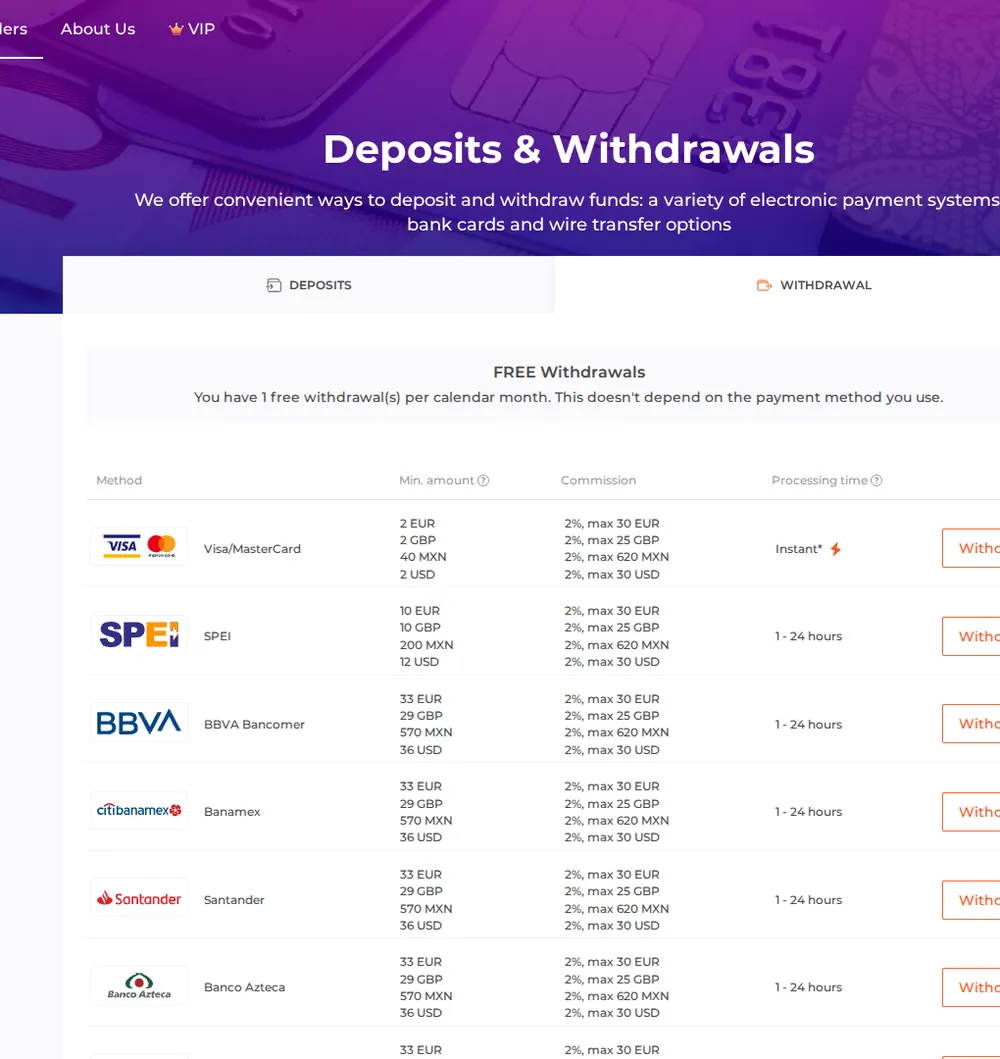 IQ Option’s withdrawal conditions for a Mexican account, 4 October 2026
Deposit fees
The official fee pages list no deposit fee. If you pay in a currency other than your account currency, your bank or card provider may charge for the conversion. The minimum deposit is covered in our minimum deposit guide and the payment steps in how to deposit funds.
How to check the fees for your own account
- Find out which company your account is with: it is named in the Terms & Conditions linked at the bottom of the IQ Option site you log in to.
- Open that site’s Trading Specifications page (trading hours and fees) for overnight funding, inactivity and closure fees.
- Before each withdrawal, read the commission line in the withdrawal form.
- Use the free Practice balance first: it shows the payout of each asset, so you can work out the win rate a strategy needs before you risk money.
📚 Continue Learning
Frequently Asked Questions
Q: Does IQ Option charge trading fees?
A: There is no separate commission per trade. Options cost you through a payout below 100% (82–88% in our October 2026 test), and CFDs through the spread and overnight funding.
Q: How do I avoid the IQ Option withdrawal fee?
A: Withdraw once per calendar month: on the global platform the first withdrawal of the month is free and later ones cost 2%, at most $30. EEA clients of the EU entity pay no bank-transfer fee.
Q: What is the minimum withdrawal on IQ Option?
A: On the global platform $2 by card or e-wallet and $10–36 by bank transfer or crypto, depending on the method (checked 4 October 2026). The EU entity’s minimum is €2, or 100 EUR, USD or GBP by bank wire.
Q: Is there an inactivity fee?
A: Yes. After 90 days without a trade IQ Option may charge €10 a month, never more than your balance.
Q: Are there fees on binary options?
A: There is no spread and no overnight funding. The cost is the payout: a win pays less than a loss costs.