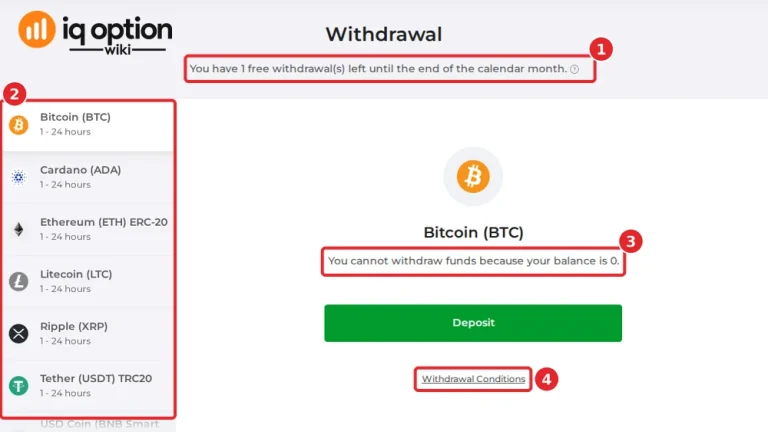
Last updated: 8 October 2026. MoreLess
Every screenshot below was recorded on 8 October 2026 on an IQ Option Practice account registered in Brazil, except the account panel in Step 1 and the settings page in Step 4a, which are from 5 October. No real-money trade was placed. The rules, fees and hours come from IQ Option’s Help pages, its Trading Specifications page, its terms and its blog, which we read on 5 October 2026; the figures for gold itself come from the recording and are listed in the table “What we recorded on 8 October 2026”. Gold’s row on the Trading Specifications page was read on 8 October 2026, on the Commodities tab, for the schedule of 5 to 11 October 2026. Nothing here forecasts the gold price or promises a profit.
On IQ Option you trade gold as a CFD, a contract on the gold price rather than the metal: open it from the Margin menu, Commodities group, choose Buy or Sell, an amount and a leverage (the multiplier of IQ Option’s Help), and you can set a take profit and a stop loss; it has no expiry. Gold also appears among the options as Gold, where a trade has a fixed payout and an expiry but no stop loss or take profit. IQ Option’s blog says gold is often used as a safe haven and responds to inflation figures, central bank policy and geopolitical unrest, and no source we read says where its price will go.
Quick answer
- What it is: a CFD pays the difference between the opening and the closing price in cash. IQ Option does not deliver gold (Order Execution Policy).
- Where to find it: + in the top bar, then Margin and Commodities; the instrument is listed as Gold (the group also holds Gold/GBP, Gold/EUR, Gold/THB and Gold/Silver). The gold option appeared as Gold in the Blitz and Binary lists on 8 October 2026.
- Profit and loss: (closing price ÷ opening price − 1) × multiplier × investment for a long position, so the multiplier magnifies losses as well as gains (IQ Option’s Help); the order panel labels it Leverage.
- Stop loss and take profit: a CFD has both, set as a percentage, an amount of money or an asset price; a binary option has neither.
- Costs: the spread on every trade and a swap on positions held overnight. On 8 October 2026 gold showed a spread of 0.3 in the asset list and a leverage of ×800; gold’s row on the Trading Specifications page showed a minimum spread of 0.005%, a maximum leverage of 1:800, a minimum margin requirement of 0.13%, a long swap of -0.0331% and a short swap of -0.0088%.
- Hours: the Trading Specifications page gives them per instrument in UTC+01 and is updated every Monday; for 5 to 11 October 2026 the Gold row ran from Sunday 23:00 to Friday 21:45, with a break from 22:00 to 23:00 on Monday to Thursday.
- Price drivers: IQ Option’s blog says gold is often used as a safe haven and responds to inflation figures, central bank policy and geopolitical unrest. It gives no direction and no forecast.
Why Trade Gold as a Commodity on IQ Option?
- A commodity CFD. IQ Option lists CFDs on commodities, and its beginner’s guide names gold among the margin instruments, next to oil, silver and corn.
- Both directions. A CFD has a higher ASK price, at which you buy (go long), and a lower BID price, at which you sell (go short), so you can trade a falling price as well as a rising one. The gap between the two is the spread.
- A multiplier. It lets a position exceed the money invested in it. IQ Option’s Help gives the example of $100 earning returns comparable to $1,000, and says losses grow in the same way.
- Options too. Gold also appears among the options as Gold (on 8 October 2026 in the Blitz and Binary lists); see the section on gold options below.
- Practice first. The Practice balance starts at $10,000, and its trades are not executed in the market, so it teaches the order panel but not real fills.
The Basics of Trading Gold on IQ Option
A CFD (contract for difference) is a contract between you and IQ Option to exchange the difference between the instrument’s value when you open the trade and its value when the contract ends. Nothing is delivered: IQ Option’s Order Execution Policy says its CFDs are cash settled and that IQ Option is the counterparty to your trade. In IQ Option’s Help a CFD has no expiration time, and your profit depends on the difference between the entry price and the closing price.
| Feature | Gold CFD (Margin) | Gold option (Options) |
|---|---|---|
| Where to find it | + in the top bar, then Margin and Commodities | + in the top bar, then Options, or search for gold: Gold in the Blitz list |
| How long it lasts | No expiry: it stays open until you close it or a take profit, a stop loss or a close-out ends it | A fixed expiry time, chosen from a list of clock times (see the gold options section) |
| What you get | (closing price ÷ opening price − 1) × multiplier × investment for a long position, and the mirror for a short one | A fixed payout percentage if you are right (90% in the Blitz and Binary lists on 8 October 2026); if you are wrong you lose the amount invested |
| Stop loss and take profit | Yes | No |
| Direction | Buy or Sell | Higher or Lower |
Steps to Trade Gold on IQ Option
- Switch to the Practice balance.
- Open the + menu, choose Margin and find Gold in the Commodities group.
- Read gold’s spread, leverage, swap and trading hours before you open anything.
- Choose the margin mode, the amount and the leverage.
- Set a take profit and a stop loss.
- Click Buy if you expect the price to rise or Sell if you expect it to fall, then watch the position and close it when your plan says so.
How to open a gold CFD on a Practice balance
The numbers in each screenshot match the numbers in the text.
Step 1: Switch to the Practice balance
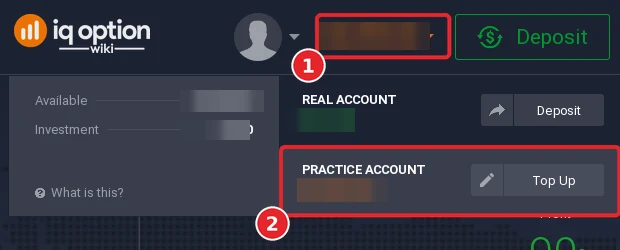
Click your balance in the upper-right corner (1). The panel that opens lists a REAL ACCOUNT and a PRACTICE ACCOUNT; click the PRACTICE ACCOUNT row (2) to make it active. The Practice row has a Top Up button, and the Practice balance starts at $10,000 with a Refill to $10,000 button. IQ Option’s Help describes the same route and says you cannot profit from Practice trades, which are virtual.
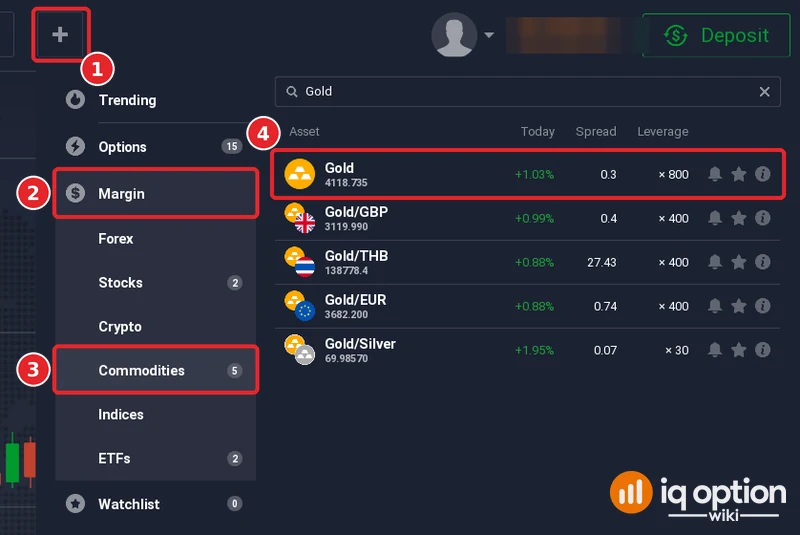
Click + in the top bar (1). The menu lists Options (Blitz, Binary, Digital), Margin and Trending. Open Margin (2), then the Commodities group (3), and choose Gold (4). On 5 October 2026 the Margin groups held 697 assets between them (Forex 44, Stocks 499, Crypto 80, Commodities 23, Indices 21 and ETFs 30), so type gold in the Search by name or ticker box rather than scrolling. The search showed five gold assets: Gold, Gold/GBP, Gold/EUR, Gold/THB and Gold/Silver. The list shows each asset’s change today, its spread and its leverage; at 09:49 (UTC-3) on 8 October 2026 Gold showed +1.01% today, a spread of 0.3 and a leverage of ×800 (0.26 and ×800 on 5 October). Choose the one named Gold; its tab opens as Gold, Commodity.
Step 3: Read what gold costs and when it trades
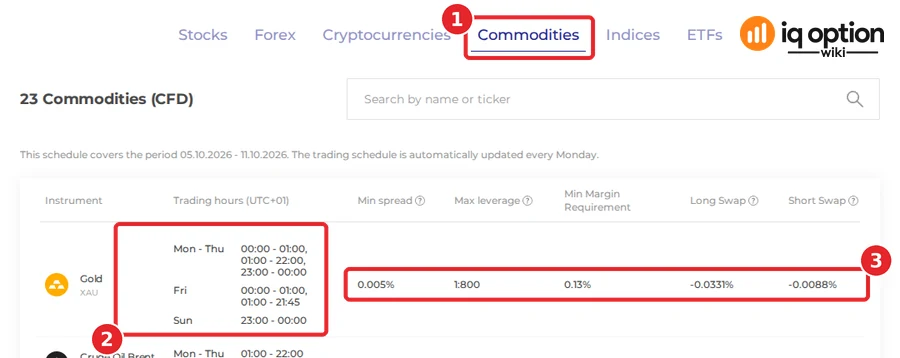
IQ Option’s Trading Specifications page has one tab per group (Stocks, Forex, Cryptocurrencies, Commodities, Indices and ETFs) and lists for each instrument the trading hours, the minimum spread, the maximum leverage, the minimum margin requirement and the long and short swap. The schedule covers one week and is updated every Monday; the page we read on 5 October 2026, for 5 to 11 October 2026, gave the hours in UTC+01. Gold is a commodity, so its row is on the Commodities tab (1), the first row of the list. On 8 October 2026 it read: trading hours (UTC+01) Monday to Thursday 00:00 to 01:00, 01:00 to 22:00 and 23:00 to 00:00, Friday 00:00 to 01:00 and 01:00 to 21:45, Sunday 23:00 to 00:00 (2); minimum spread 0.005%, maximum leverage 1:800, minimum margin requirement 0.13%, long swap -0.0331% and short swap -0.0088% (3). Read as a week, gold trades from Sunday 23:00 to Friday 21:45 with a break from 22:00 to 23:00 on Monday to Thursday.
The page changes every Monday, so read gold’s row again before you trade. The traderoom showed the same leverage, ×800, in the asset list (Step 2), and a spread of 0.3 there; beside the Buy and Sell buttons the spread moved between 0.17 and 0.38 during the recording, because it moves with the market. The page gives the minimum spread as a percentage and the traderoom shows it in points, so the two numbers are not the same unit.
| Column | What it tells you |
|---|---|
| Trading hours (UTC+01) | When the instrument can be traded; no orders are accepted outside the underlying market’s hours |
| Min spread | The smallest gap between the buy and sell price |
| Max leverage | The largest leverage allowed, which the order panel works with as the multiplier |
| Min Margin Requirement | The margin needed to open a position, a percentage of its full value |
| Long swap | The overnight funding for a buy position, as a percentage |
| Short swap | The overnight funding for a sell position, as a percentage |
The swaps are shown with a minus sign: -0.0331% long and -0.0088% short for gold, and on the Stocks tab we saved on 5 October -0.0438% long and -0.0301% short for each of the first 20 stocks listed. The Trading Conditions page of the asset (the info button of the asset list, then Trading Conditions) says what the sign means: “A positive swap is credited to your account, a negative swap is debited from your account when you hold an open position overnight”, so these minus signs are charges. For gold that page showed Swap Buy (yearly) -12.07% and Swap Sell (yearly) -3.21%, a floating spread of 0.29, a minimum quantity of 1 and a leverage of ×800; its schedule in UTC-3 gave a funding time of 19:00, daily swaps of -0.0331% and -0.0088%, three times that on Friday (-0.0992% and -0.0264%) and no fee on Saturday and Sunday.
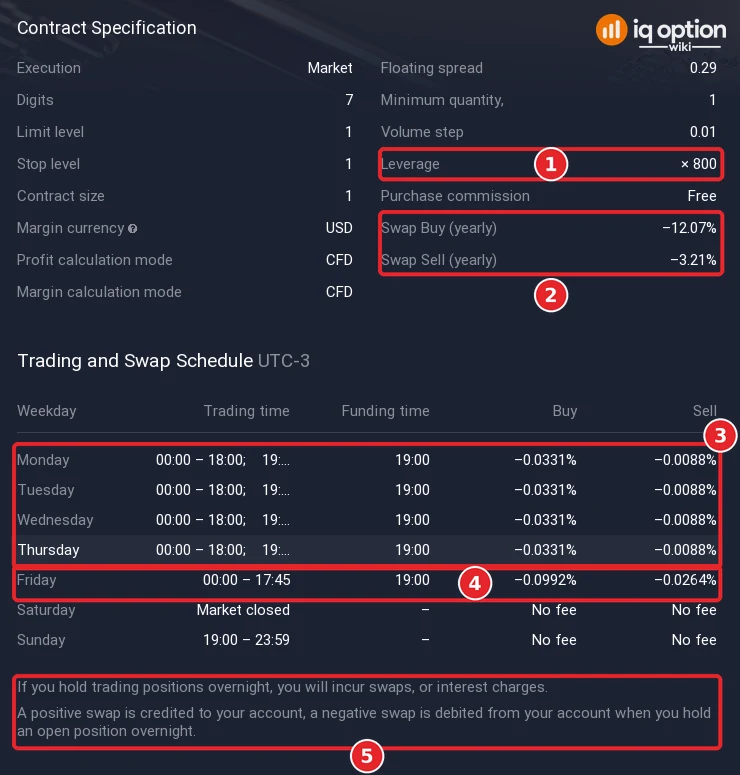
IQ Option adds that the spread can vary with market conditions and liquidity and that overnight funding may be charged for open positions.
Step 4: Choose the margin mode, the amount and the multiplier
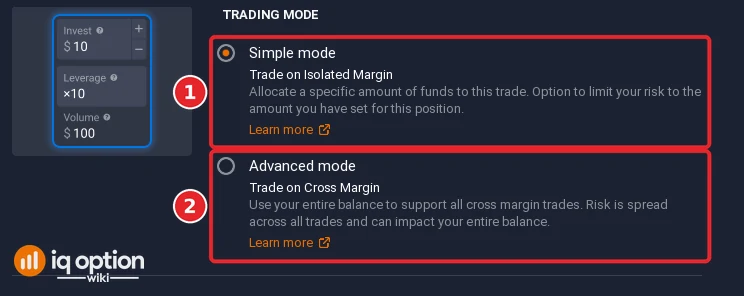
IQ Option’s margin terms describe two modes. Isolated Margin (Simple Mode) allocates a fixed investment to each position, and an isolated position’s maximum loss is limited to that margin; a stop loss that needs more margin than the investment, or the “use balance to keep position open” option, can extend it. Cross Margin (Advanced Mode) makes the whole balance collateral for all open positions, and a margin call can put every position at risk of liquidation. In Simple Mode you cannot hold opposite positions on the same asset.
4a. Open the settings (the gear icon at the bottom of the screen), then the Trading page. Under Trading mode choose Simple mode (1), which the page describes as “Trade on Isolated Margin”, or Advanced mode (2), “Trade on Cross Margin”. Simple mode was selected in our recording. The choice is made with two radio options; no separate confirm button was visible in the recording.
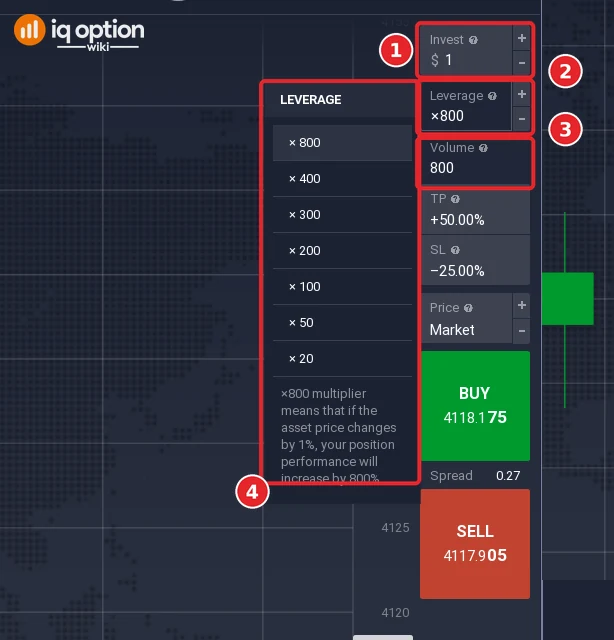
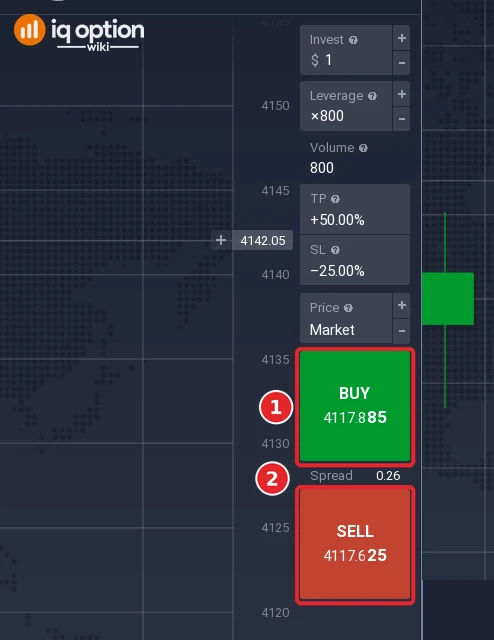
4b. On the order panel type the amount in the Invest box (1) and set the Leverage box (2), which IQ Option’s Help calls the multiplier. The Volume line (3) shows the result: for gold an Invest of $1 at ×800 showed a Volume of 800, and at ×20 a Volume of 20. Click the Leverage box and a list opens (4) with ×800, ×400, ×300, ×200, ×100, ×50 and ×20, and a note that “×800 multiplier means that if the asset price changes by 1%, your position performance will increase by 800%.” The Invest box opened at $1. IQ Option’s Help gives $20,000 as the maximum investment per trade and says it may vary by asset.
The Help’s profit formula for a long position is (closing price ÷ opening price − 1) × multiplier × investment, and for a short position (1 − closing price ÷ opening price) × multiplier × investment. With $100 at a multiplier of 10, a 1% rise gives $10, a 1% fall costs $10, and a 10% fall equals the whole $100. This is arithmetic, not a forecast for gold.
Step 5: Set a take profit and a stop loss
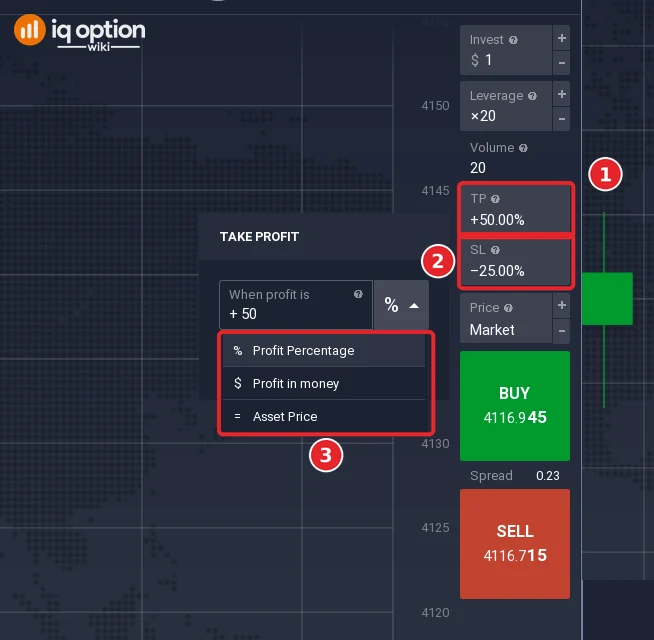
IQ Option’s Help defines a stop loss as an order that limits the loss on an open position and a take profit as one that locks in a profit at a price level. Click TP (1) for the take profit and SL (2) for the stop loss, then enter each value in the unit you choose (3). In our traderoom the panel showed TP at +50.00% and SL at −25.00%; these values may have been saved from an earlier session, so we do not call them defaults. Clicking a field opens a small window, TAKE PROFIT (“When profit is”) or STOP LOSS (“When loss is”), with the value, a unit selector and the line “These preferences will be applied to the new position you open”; the stop loss window also has a box, “Use Balance to Keep Position Open”, which was unticked. The Help says the parameters can be set as a percentage, an amount of money or an asset price; the take profit window we recorded (headed TAKE PROFIT, “When profit is”) offered three units: % Profit Percentage, $ Profit in money and = Asset Price. You can change both after the position is open, according to the General Terms.
| Unit | What you enter |
|---|---|
| Percentage | A percentage of the amount invested: on a $1.00 investment the platform drew +50% as +$0.50 and −25% as −$0.25 |
| Amount of money | An amount of profit or loss in your account currency |
| Asset price | A gold price level |
A stop loss closes the position at the market, so it can fill away from its level: the Help warns that slippage can occur with stop loss and take profit orders, most likely when volatility is high, and the blog says gold can move fast.
Step 6: Click Buy or Sell
Click Buy (1) if you expect the gold price to rise or Sell (2) if you expect it to fall. A buy opens at the higher ASK price and a sell at the lower BID price, so a new position starts behind by the spread. The Trading page of the settings has Open positions without confirmation boxes, one of them for Forex, Stocks, ETFs, Commodities and Crypto. The page says that on the Practice account you do not need to confirm opening positions by default, and the real-account boxes were unticked in our recording. With the box ticked, a click submits the order without a confirmation window (General Terms); check it before you click.
Step 7: Watch the position and close it
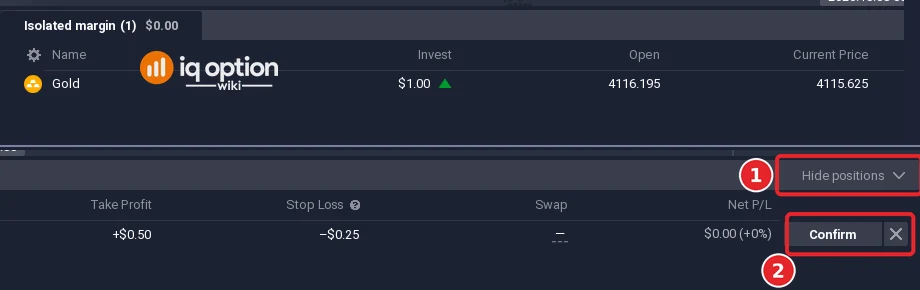
Open the positions list with Show positions in the bottom-right corner; the same button then reads Hide positions (1); IQ Option’s blog says it shows the current profit or loss in percent and in your account currency. Click Close in the row of the position and the button turns into Confirm (2), with a cross beside it to cancel; click Confirm to end the position. Once a position is open, a bar at the top of the chart shows its direction, opening price, investment and profit or loss with a Close button; you can also leave the position to the take profit or the stop loss. A CFD has no expiry, but IQ Option’s margin terms say it closes open positions automatically if the account equity falls below 50% of the maintenance margin requirement.
What we recorded on 8 October 2026
This table lists what the Practice account showed for gold on the recording day. It describes one session, not gold in general, and it says nothing about what the next trade will do.
| Item | Recorded |
|---|---|
| Time of recording | 8 October 2026, 09:49 to 09:53 on the traderoom clock (UTC-3) |
| Balance | Practice account (it starts at $10,000); the Invest box opened at $1 |
| Menu path and instrument name | + > Margin > Commodities > Gold (search results: Gold, Gold/GBP, Gold/EUR, Gold/THB, Gold/Silver); the tab opened as Gold, Commodity |
| Trading Specifications row for gold | read on 8 October 2026 on the Commodities tab (schedule of 5 to 11 October): minimum spread 0.005%, maximum leverage 1:800, minimum margin requirement 0.13%, long swap -0.0331%, short swap -0.0088% |
| Margin mode | Isolated margin (the positions panel was headed Isolated margin); Simple mode on the settings page |
| Order | Buy, $1.00, leverage ×20 (volume 20) |
| Take profit and stop loss | take profit +50.00% (+$0.50) and stop loss −25.00% (−$0.25), both in percent, as shown in the panel |
| Buy and sell price when the position opened | opened at 4116.195 (position bar and Open column); the spread beside the Buy and Sell buttons moved between 0.17 and 0.38 during the recording |
| How the position ended | closed by hand less than a minute later with Close and Confirm: the Current Price column read 4114.905 when we clicked Close, which the Help’s formula turns into (4114.905 ÷ 4116.195 − 1) × 20 × $1 = −$0.006, and the panel and the balance showed a net result of −$0.01 |
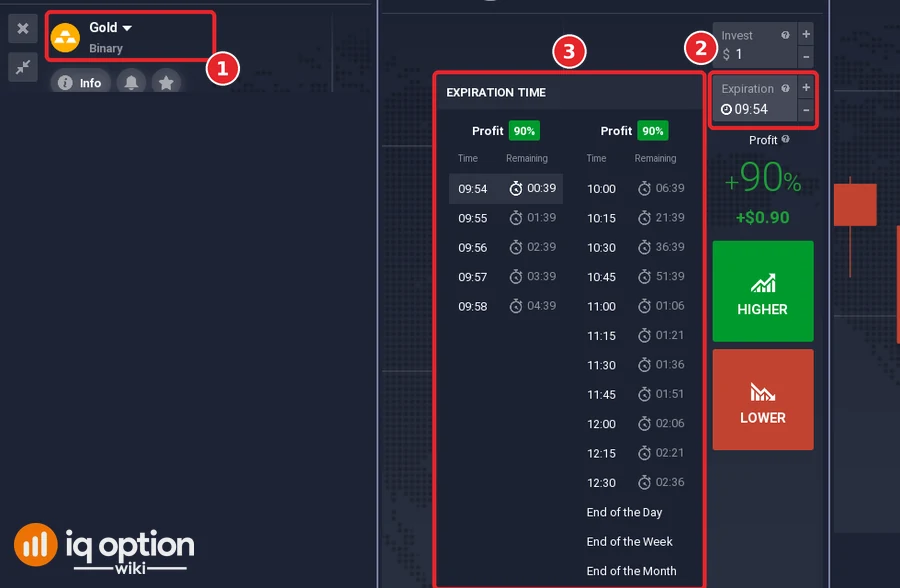
| Gold option | Gold in the Blitz and Binary lists, payout 90%; the Binary expiration list offered the next five minutes one by one, then 10:00 to 12:30 in quarter-hour steps, and End of the Day, End of the Week and End of the Month, all at 90% |
One Practice trade shows how the order panel works. It is not evidence about gold or about any strategy, and no result here is a promise of profit.
What it costs to trade gold: spread and swap
The spread
The spread is the gap between the ask and the bid. IQ Option’s Order Execution Policy says a spread is applied in most circumstances and can be changed in conditions such as increased volatility or illiquidity; its blog says spreads often widen at market open and close, around major news and central bank decisions, and in thin sessions. Read the spread you see when you open the trade and compare it with your target. The blog’s rough guide is that under 5% of the target is usually manageable and above 30% is usually too expensive for short-term trading, though it calls these ranges a sanity check, not rules.
The swap
The swap, or overnight funding, is a charge or credit for keeping a leveraged position open after the daily rollover time. The Trading Specifications page lists a long and a short swap as percentages. The blog’s formula for a swap shown as a percentage is swap = position value × daily swap rate × chargeable nights, where the position value is the full exposure: on IQ Option, the amount invested times the multiplier. As an illustration with figures that are not gold’s, $100 at a multiplier of 10 is a position value of $1,000, and at 0.05% a night one chargeable night costs $0.50.
- A weekend may count as more than one chargeable night. The blog says the day and the rate vary by instrument and that the live conditions are the only safe reference. Gold’s swap on 8 October 2026 was -0.0331% long and -0.0088% short, and the Trading Conditions page shows how the weekend is counted: Friday carries three times the daily swap (-0.0992% for a long position) and Saturday and Sunday carry no fee. The position’s Swap column in the positions list shows what was actually charged. As an illustration with gold’s long swap and the blog’s formula, a $1 position at ×20 is a position value of $20, and 0.0331% of it is about $0.0066 for one chargeable night. We did not hold a position overnight, so we did not see a swap charged.
- IQ Option’s Order Execution Policy says it may charge a swap of up to 0.5% of the face value of the position for keeping it open overnight, and that the fee can change. Its General Terms say swaps are deducted from your investment or balance, and a position is closed if the balance cannot cover them.
- A swap-free (Islamic) account: IQ Option’s page says it has no interest and no overnight fees, while its terms mention a one-time non-refundable payment, and the two do not agree; spreads and commissions still apply. See our Islamic account guide.
Gold options
On 8 October 2026, a Thursday, a search for gold in the + menu showed Gold in the Blitz list and in the Binary list, each with a payout of 90%; the platform also lists OTC assets, such as EUR/USD (OTC). OTC means over the counter: IQ Option’s Help says it is a trading method available when markets are closed, with quotes generated on IQ Option’s server, and its General Terms say an OTC asset’s price is formed from its clients’ trade requests and orders, with the main server for those orders as the only source of quotes. So an OTC chart shows IQ Option’s own quotes, not the market’s. The Help says IQ Option switches to OTC every Friday at 21:00 GMT and back every Monday at 00:00 GMT. We did not look at gold at the weekend.
An option on gold (1) has an expiry time, chosen in the Expiration box (2) from a list of clock times (3), and a fixed payout shown next to the asset (90% in the Blitz and Binary lists on 8 October 2026), and no stop loss or take profit. IQ Option’s blog says it can be sold before expiry with the Sell button; see selling options before expiration. To come out ahead it has to win about 54.1% of the time at an 85% payout (1 / 1.85) and about 53.5% at 87%. IQ Option showed payouts of 82% to 91% on options between 2 and 4 October 2026, and its Help says it may change the percentage at any time.
Factors Affecting Gold Prices
IQ Option’s blog names a few things gold responds to and gives no direction for any of them.
| Factor | What IQ Option’s blog says |
|---|---|
| Inflation figures | Gold responds to them |
| Central bank policy | Gold responds to it |
| Geopolitical unrest | Gold responds to it, and is often used as a safe haven |
| The US dollar | Gold reacts differently to a US dollar spike than the Nasdaq or the Japanese yen do |
| Global events, supply and demand | Commodities such as gold, oil and silver are influenced by global events, demand and supply, and macroeconomic trends |
“Responds to” does not say how, so treat these as a reason to check the economic calendar, not as a rule for direction. See how to read the economic calendar.
Gold Trading Strategies for IQ Option
IQ Option’s blog gives no trading rules written only for gold; where its general strategy advice mentions gold we say so. We did not test any of the four ideas below on gold. Each is described as the blog describes it.
1. Support and Resistance Strategy
Support is a price area where buyers have stepped in hard enough to stop a decline; resistance is the mirror image. The blog advises drawing zones rather than single lines, waiting for a reaction at the zone (a rejection close, a shift in structure, or a squeeze followed by a move out) instead of buying the touch, keeping five levels at most, and naming where the idea is wrong before you enter, with the stop beyond the zone. It adds that gold does not behave like EUR/USD, so the buffers and the rules for accepting a break have to adjust. See support and resistance on IQ Option.
2. Trend Following Strategy
An uptrend is a series of higher highs and higher lows, a downtrend the reverse, and a range has neither. The blog says trend entries usually come after pullbacks rather than during impulsive moves, and for gold it suggests the 5-minute, 15-minute and 1-hour charts, with the 1-hour chart for context because gold can move fast. A moving average shows direction but does not predict the future. See moving averages on IQ Option.
3. Scalping Strategy
Scalping means many short trades for small price changes, and the blog says it often needs more leverage, which adds risk. Costs weigh most on short trades because the spread is paid at once: the blog’s example is a 1-pip spread on a 5-pip target, already 20% of the target. Compare gold’s spread (0.3 in the asset list on 8 October 2026, and between 0.17 and 0.38 beside the Buy and Sell buttons during the recording) with your target.
4. Breakout Strategy
A breakout is a move outside a level that price has respected several times. The blog says what matters is closing beyond it, because many false signals are brief pokes that snap back, and it describes two entries: on the close of the breakout candle, or on a retest of the old level, which is more conservative. Its target is the measured move, the breakout level plus the height of the range, which it calls a structure for the trade, not a point where price must stop. See breakouts on IQ Option.
Technical Analysis Tools
The indicators button (a wave icon) at the bottom left of the chart opens the Chart analysis panel, with tabs for Indicators, Templates, Widgets and Scripts. None of these tools predicts the gold price; each describes what price has been doing.
- Moving Average: the average price over a number of periods, which smooths short-term swings so the direction is easier to read. See moving averages on IQ Option.
- Relative Strength Index (RSI): a momentum scale from 0 to 100; above 70 is called overbought and below 30 oversold, and the blog says these levels do not predict the next candle. See RSI on IQ Option.
- Stochastic Oscillator: shows where the latest close sits in a recent high-low range; the blog says above 80 is not an automatic sell signal and below 20 not an automatic buy signal. See the stochastic on IQ Option.
- Fibonacci retracement: horizontal lines at ratios such as 23.6, 38.2, 50, 61.8 and 78.6 between a swing high and a swing low, as possible pause or reversal areas; the blog says it is meant for trending markets. See Fibonacci levels on IQ Option.
- Average True Range (ATR): how much price has been moving, not which way. Fourteen periods is a common setting, not a rule, and the blog’s stop distance is ATR × a multiplier that you test on the same instrument and timeframe.
Pros and Cons of Trading Gold on IQ Option
| Pros | Cons |
|---|---|
| A CFD can be bought or sold, so you can trade a falling price as well as a rising one. | The multiplier magnifies losses as well as gains, and IQ Option’s Help says so. |
| A stop loss and a take profit can be set and changed after the position is open (General Terms). | A stop loss can fill away from its level: the Help warns of slippage, most likely when prices move fast. |
| With Isolated Margin the maximum loss on a position is limited to its margin, unless you extend it. | With Cross Margin the whole balance is collateral, and a margin call can put every position at risk. |
| A CFD has no expiry, so a clock does not end it. | The spread is paid on every trade and a swap on positions held overnight. |
| The Practice balance lets you rehearse the order panel at no cost. | Practice trades are not executed in the market, and gold follows its own trading hours: IQ Option does not accept orders outside them. |
Tips for Managing Risks When Trading Gold
- Fix the stop loss before the entry. IQ Option’s blog says a stop loss defines the risk before the trade begins, and that if you cannot name where you are wrong you do not have a trade. Widening a stop after entry raises the planned loss and breaks the size you calculated.
- Size the position from the stop. The blog’s ATR guide says the stop defines the size, not the other way round. On IQ Option the loss at the stop is about the stop distance, as a share of the opening price, × the multiplier × the amount invested (from the Help’s formula, before spread and slippage). To risk $10 with a stop 0.5% from the opening price at a multiplier of 10, invest $10 ÷ (0.005 × 10) = $200. These figures are arithmetic, not advice for gold.
- Risk a small share per trade. The blog says never to risk more than 1% to 2% of your capital on one trade, and to start with small sizes even on a real account.
- Check the risk/reward ratio. The break-even win rate is 1 ÷ (1 + ratio): 50% at 1:1, 33.3% at 1:2 and 25% at 1:3, before costs. The blog says the real figure is 1 to 3 percentage points higher once spread and commissions count.
- Read the costs, the hours and the news. Check the spread, swap and trading hours before you open or hold a position. The blog says economic releases can disturb normal price behaviour for 10 to 30 minutes and suggests standing down, widening zones and shrinking size, or having a news plan. Keep a trading journal, as the blog advises.
Common Mistakes to Avoid
| Mistake | Consequence | What to do instead |
|---|---|---|
| Ignoring the spread and the swap | The trade starts behind by the spread, and a position held for days pays a swap for each chargeable night | Read gold’s spread and swap on the Trading Specifications page first |
| Widening the stop after entry | The planned loss grows and the size you calculated no longer fits | Decide the stop before the entry, and move it only toward break-even or by a rule set in advance |
| Holding a short-term trade into a closure or a weekend | The market can gap when it reopens, and a stop loss may fill away from its level | Check the instrument’s hours, and do not hold into a closure unless that is the plan |
| Clicking with confirmation switched off | The order is submitted without a confirmation window | Check the Open positions without confirmation boxes in the settings before you click |
Conclusion
Gold on IQ Option is a CFD with a multiplier, a spread, a swap and trading hours of its own, and an option with a fixed payout and no stop loss. None of the sources we read says gold is stable, profitable or suitable for beginners, and IQ Option’s blog says gold can move fast. Learn the order panel on Practice, read the costs before every trade, and treat the four strategies above as ideas to test, not as rules that work.
Related guides
- What is a CFD? and What is leverage?
- How to calculate profit in CFD trading on IQ Option
- Auto closing: take profit and stop loss on IQ Option
- Pending orders on IQ Option
- When to trade on IQ Option: sessions, OTC and time zones
- IQ Option fees and commissions and money management
- All indicator guides and all strategy guides
Frequently Asked Questions
Q: Is gold a good commodity for beginner traders?
A: No source we read says so. IQ Option’s blog says gold can move fast. Start on the Practice balance and read the costs first.
Q: What factors influence gold prices?
A: IQ Option’s blog says gold is often used as a safe haven and responds to inflation figures, central bank policy and geopolitical unrest. It gives no direction for any of them, and no source we read says what gold will do next.
Q: Can I practice gold trading without risking real money?
A: Yes. The Practice balance starts at $10,000 and can be topped up for free. Its trades are not executed in the market, so it shows how the order panel works, not how real orders are filled.
Q: How much should I invest when starting to trade gold?
A: IQ Option’s blog advises risking no more than 1% to 2% of your capital on one trade and starting small. The Invest box of the gold order panel opened at $1 on 8 October 2026 (check the minimum on the panel), and IQ Option’s Help gives $20,000 as the maximum per trade, which can vary by asset.
Q: Does IQ Option offer leverage on gold trades?
A: Yes, as the multiplier on a CFD. The Leverage list for gold on 8 October 2026 went from ×20 up to ×800. It magnifies losses as well as gains.
Q: Does a gold trade have a stop loss and a take profit?
A: A CFD does, and you can change both after the position is open. A binary option on gold does not: it closes at its expiry time.
Q: What does it cost to trade gold on IQ Option?
A: A spread on every trade and a swap on positions held overnight. The Trading Specifications page lists gold’s minimum spread and its long and short swap (on 8 October 2026: a minimum spread of 0.005%, a long swap of -0.0331% and a short swap of -0.0088%), and IQ Option says the spread can vary with market conditions and liquidity.
Q: Can I trade gold at the weekend?
A: We did not look at gold at the weekend, so we cannot say whether it is offered. IQ Option’s Help says it switches from market quotes to OTC every Friday at 21:00 GMT and back every Monday at 00:00 GMT. The hours of the CFD are on the Commodities tab of the Trading Specifications page: for 5 to 11 October 2026 the Gold row showed a Sunday session from 23:00 and a Friday close at 21:45, in UTC+01. On Thursday 8 October 2026 the options lists showed gold as Gold in the Blitz and Binary lists, at a payout of 90%.